Yeni başlayanlar için kılavuz
Quantitative investing is essentially a method of analyzing and trading markets using mathematical models, statistical methods, and programmed systems. Unlike traditional investing, which relies on subjective judgment, quantitative investing emphasizes rules-based and data-driven approaches, requiring all trading logic to be converted into conditions executable by programs.
A complete quantitative system typically consists of the following components:
Data acquisition
Signal generation
Strategy execution
Risk control
Performance evaluation
These modules together form a closed-loop automated investment system.
For example, when the system detects that a certain asset simultaneously meets the following conditions:
Decreasing volatility
Increasing capital inflows
Strengthening market sentiment
The model may automatically generate a buy signal without requiring manual analysis.
As market complexity increases, modern quantitative systems have evolved beyond simple program trading and now function more like continuously learning financial decision-making systems.
AI applications in financial markets are not based on a single technology, but are the result of multiple models working together. Different models are suited to different problems. For instance, some models excel at predicting price trends, while others are better at analyzing news sentiment or identifying abnormal risks.
Currently, commonly used AI technologies in finance can be roughly categorized as follows:
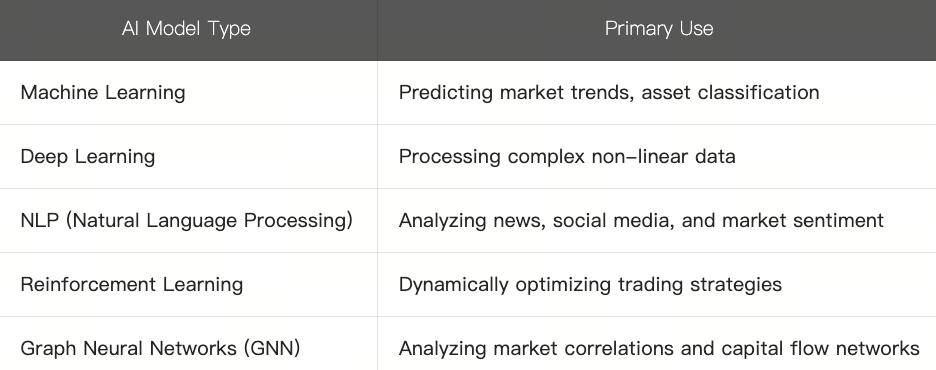
Among these, the development of natural language processing has had a particularly significant impact on financial markets. In the past, researchers had to manually read large volumes of news and financial reports; now, AI can automatically analyze:
Changes in news tone
Sentiment on social media
Key points in company announcements
Directions of macroeconomic policy
This has further accelerated the speed at which the market responds to information.
At the same time, reinforcement learning models are also being applied to dynamic trading systems. Unlike traditional fixed rules, these models continuously adjust their strategies based on market feedback, similar to traders in ongoing training.
In quantitative investment systems, factors have always been a core concept. A factor can be understood as a quantifiable characteristic that affects asset price movements. In the past, quantitative investment mostly revolved around building trading logic and asset allocation strategies based on specific factors.
Common traditional factors include momentum, value, volatility, and market capitalization factors. For example, the momentum factor assumes that upward trends may continue; the value factor tends to look for undervalued assets; while volatility and market capitalization factors focus on the impact of market risk and asset size on returns, respectively.
Previously, these factor models were mainly constructed using financial theory, statistical methods, and the experience of investment managers. In other words, researchers would first propose a hypothesis and then verify its validity through historical data. However, with the introduction of AI and machine learning technologies into quantitative investing, this logic has begun to change. Today's models no longer just use existing factors—they can proactively discover factors from massive datasets.
For example, a machine learning model might identify hidden correlations between certain market sentiments and price fluctuations or recognize relationships between specific capital flows and the probability of asset appreciation. The model can even dynamically assess which factors remain effective and which have become obsolete under different macroeconomic conditions.
This means AI's role is no longer limited to executing existing strategies but is continuously uncovering new market patterns and constantly adjusting its own decision logic. However, this capability also introduces new challenges. Because machine learning models are highly skilled at finding patterns in data, they may sometimes identify seemingly effective rules that are actually historical coincidences. In other words, the model might simply memorize historical data rather than truly understand market logic.
Modern AI quantitative systems increasingly emphasize factor stability, model generalization ability, and adaptability to different market environments. Only models that can remain effective across cycles and markets have the potential to operate in real markets over the long term.
There is a classic saying in quantitative investing: any strategy can make money—until it actually enters the market. What this reflects is the critical importance of risk control.
An outstanding intelligent investment system is not just about trading—it is even more about managing risk. Long-term performance is often determined not by single returns but by whether the system can survive extreme market conditions. Therefore, risk control typically runs through the entire AI investment system. The most fundamental aspect is position management: the system must decide how much capital to allocate to each trade to avoid excessive concentration of risk due to fluctuations in a single asset. Additionally, when abnormal market volatility occurs, the system automatically reduces risk exposure through stop-loss and risk control rules—for example, by reducing positions, pausing trading, or increasing cash holdings to prevent further losses from dramatic market changes.
Correlation control is also a crucial part of quantitative investing. Many assets may appear diversified on the surface but can move in high correlation under market stress. If the system cannot identify true relationships between assets, there is a risk of apparent diversification but actual concentration.
Besides real-time risk management, backtesting is also an indispensable mechanism in quantitative systems. Backtesting involves using historical market data to simulate past performance of a strategy to verify its effectiveness.
A complete backtesting process usually includes importing historical data, establishing strategy rules, simulating historical trading processes, calculating return and risk indicators, and analyzing strategy stability. Through these processes, developers can better understand how models perform during different market phases.
However, backtesting has its limitations. Historical performance does not guarantee future results. Many models perform exceptionally well on historical data but fail quickly when deployed in real markets—a situation commonly referred to as overfitting. To mitigate this risk, modern AI investment systems increasingly stress multi-market testing, validation across different cycles, stress testing, and simulations of extreme market scenarios. Only models that can adapt to complex market environments and maintain stability under various conditions have a better chance of operating over the long term.