Yeni başlayanlar için kılavuz
Most past AI tools were still passive response systems—in other words, the system would only provide results when users asked questions. However, with the rise of the AI Agent (intelligent agent) concept, AI is evolving from a tool into an active collaborator.
The core features of an AI Agent are that it can not only analyze information but also:
Execute tasks autonomously
Continuously track market changes
Dynamically adjust behavior based on objectives
Operate collaboratively with multiple systems
In investment scenarios, this means AI is no longer just providing an analysis report; it may become a long-term "digital investment assistant."
For example, an AI Agent can:
Monitor market data in real time
Automatically identify trending sectors
Analyze on-chain capital flows
Assess market risk preferences
Generate strategy recommendations
Automatically execute operations under specific conditions
The biggest change in this model is that investment processes are shifting from human-driven to system-driven collaboration.
In the future, the relationship between users and AI may shift from using tools to managing intelligent assistants.
Compared to traditional financial markets, the crypto market has a unique advantage: a vast amount of trading activity, capital flows, and asset changes are publicly traceable.
On-chain data has become an important source of information in the AI investment system. By analyzing on-chain data, AI can observe many market behaviors that traditional finance cannot access in real time, such as:
Whale address capital movements
Stablecoin inflows and outflows
Exchange capital changes
Growth trends in new wallets
DeFi protocol capital migration
Essentially, this data reflects the behavior of market participants.
For example, when large amounts of stablecoins flow into exchanges, it often signals an increase in market risk appetite; when long-term holding addresses begin to transfer assets on a large scale, it may indicate a shift in market sentiment.
Currently, the application of AI in on-chain analysis mainly focuses on several areas:
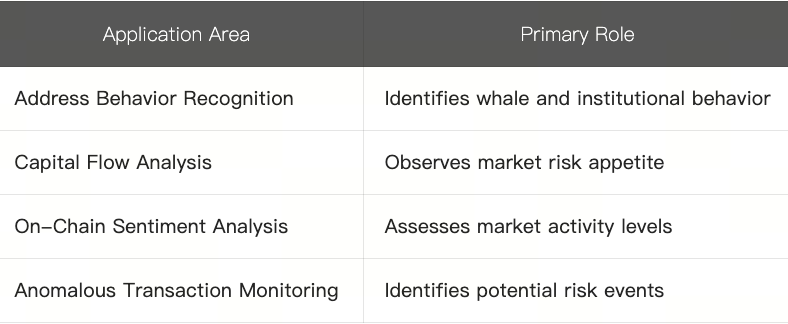
As AI models become more advanced, it's likely that AI will further enable:
Automatic detection of market manipulation
Early identification of trending narratives
Dynamic prediction of capital rotation paths
This is why on-chain data combined with AI is considered one of the key competitive directions in the crypto market.
With the development of AI technology, investment strategies are gradually shifting from manual design to automated generation. AI models can autonomously generate different types of strategies—trend-following, arbitrage, volatility, or capital rotation—based on market data.
Compared to traditional fixed-rule models, AI's main advantage lies in its ability to continuously adjust strategies according to market conditions. For example, when the market enters a highly volatile phase, the system can automatically reduce exposure to high-risk assets and optimize overall portfolio structure.
In asset portfolio management, AI also takes into account factors such as returns, volatility, asset correlations, and market sentiment, enabling investment portfolios to move from static allocations to real-time dynamic optimization.
The changes AI brings to the investment industry go beyond simply adding a few analysis tools—it's reorganizing the entire investment process. Previously, investing typically required manual information gathering, market analysis, strategy formulation, trade execution, and risk tracking; now, more and more stages are being handled collaboratively by AI.
The intelligent investment workflow of the future may start with information aggregation, where AI automatically organizes news, on-chain data, market sentiment, and macro information, then further analyzes trends, assesses risks, and generates allocation plans based on user objectives. Ultimately, the system can automatically execute trades, rebalance portfolios, and manage risk—continuously optimizing models in response to market changes.
This signals a shift in investment systems from isolated tools to fully integrated intelligent collaboration. In the future, an investor's core competitive edge may no longer be just access to more information—but who can most efficiently leverage and manage AI workflows.