Yeni başlayanlar için kılavuz
The emergence of AI Agents is driving financial markets from human-operated systems toward system collaboration systems. Unlike traditional automated trading programs, AI Agents not only execute fixed rules but also begin to understand goals, perceive environments, and make dynamic decisions.
Previous automated trading systems mostly relied on preset conditions; however, AI Agents act more like continuously operating digital researchers and traders, able to monitor markets in real time, analyze news and on-chain data, and dynamically adjust strategies and asset allocations based on changing market sentiment.
The biggest shift in this model is that systems are beginning to have continuous learning capabilities. For example, when the market moves from a high-risk preference to a defensive phase, an AI Agent can automatically reduce the proportion of high-volatility assets without manual rule modification. In the future, AI Agents may further develop into multi-Agent collaborative systems and cross-market dynamic allocation networks. At that point, the focus of competition in financial markets may shift from whose strategies are better to "who has stronger AI collaboration capabilities."
Currently, most AI financial products remain at the "decision support stage," meaning they help users analyze information, generate insights, or provide strategic references. However, as model capabilities improve, AI is gradually moving into the execution layer, which means many steps in future investment processes may be completed automatically by systems.
A typical AI automated investment process usually includes:
AI collects market and on-chain data
The system analyzes market trends and risk changes
Automatically generates allocation plans
Executes trades based on risk parameters
Continuously monitors and dynamically adjusts positions
During this process, the role of humans is beginning to change.
Previously, investors needed to personally complete:
Data analysis
Asset selection
Risk assessment
Trade execution
In the future, users are more likely to become:
Goal setters
Risk parameter managers
AI workflow supervisors
In other words, investment activities are shifting from manual operation to managing intelligent systems.
With the development of AI investment systems, the scope of asset allocation is constantly expanding.
In the past, traditional portfolios were mainly centered around stocks, bonds, and cash; now, AI systems are beginning to simultaneously handle:
Crypto assets
Stock markets
Commodity markets
Forex markets
RWA (Real World Assets)
On-chain yield assets
This multi-asset collaboration capability will become an important direction for future intelligent investment systems.
There are often complex interrelationships between different markets. For example:
Changes in Federal Reserve interest rates may affect global risk assets
Stablecoin liquidity shifts can influence risk preferences in crypto markets
Rising gold prices may signal increased risk aversion
AI's advantage lies in its ability to analyze these cross-market signals simultaneously and dynamically adjust allocation structures.
From a model perspective, future asset allocation systems may place greater emphasis on:
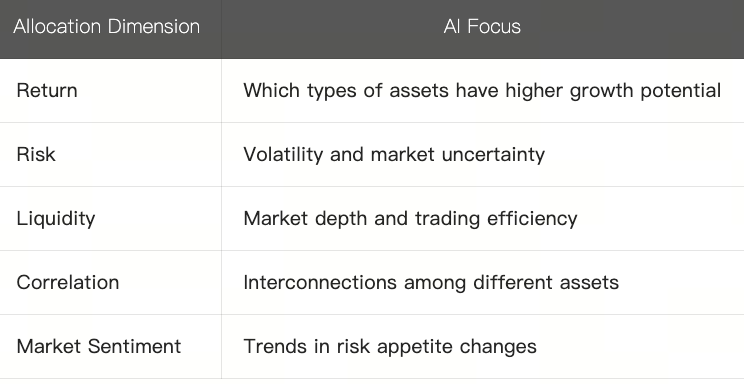
Compared to traditional fixed-ratio allocation, AI-driven dynamic models place greater emphasis on real-time adaptability. As a result, future investment portfolios may no longer be static structures, but rather dynamic systems that continuously change and are optimized in real time.
While AI is driving financial markets into a new phase, it also introduces new risks and regulatory challenges. Since AI models may not truly understand the market, issues such as misjudging trends, amplifying volatility, or overfitting can still arise during extreme market conditions. Especially when multiple AI systems use similar logic, model resonance may occur, further intensifying market fluctuations.
At the same time, regulatory concerns are gaining attention. As AI gradually enters the financial decision-making process, the market is increasingly focused on issues such as the transparency of automated trading, the legality of data sources, and the attribution of responsibility for AI decisions. In the future, the AI-driven financial system is likely to gradually establish more comprehensive risk control standards, model auditing mechanisms, and automated trading regulatory frameworks.
From a longer-term perspective, the financial system itself is also becoming increasingly digital and programmable. In the future, we may see deeper integration of AI and blockchain, widespread adoption of autonomous investment systems, expansion of on-chain asset scale, and further automation of financial services.
This lesson also serves as an important summary of the entire curriculum. The greatest impact of AI on financial markets may not just be improved trading efficiency, but rather the redefinition of investing itself. In the past, investing relied more on human experience and judgment; in the future, the relationship between humans and AI may gradually evolve so that humans are responsible for goals and rules, while AI handles analysis, execution, and dynamic optimization.