

Lesson 1
The New Era of AI and Asset Allocation
Over the past few decades, asset allocation has been a core topic in financial markets. Whether for traditional funds, institutional investors, or individual investors, the essential challenge remains the same: how to find the optimal balance between risk and return. However, as data volumes expand, market complexity increases, and AI technology rapidly evolves, traditional investment approaches reliant on human experience are gradually being transformed by more intelligent and dynamic model systems.
Limitations of Traditional Asset Allocation
The core logic of traditional asset allocation has long been based on historical experience and classic financial theories, such as stock-bond allocation, risk diversification, and long-term mean reversion. However, as markets enter periods of high volatility and information flows at unprecedented speeds, this model has started to reveal significant issues.
The most typical limitations include:
-
Limited data processing capabilities, making it difficult to cover massive amounts of market information
-
Investment decisions rely on manual research, resulting in lower efficiency
-
Slower response to market changes
-
Models are usually based on historical patterns and struggle to cope with unexpected events
For example, in traditional institutional research systems, the process from information gathering and industry analysis to investment decisions often takes considerable time. But today, with rapid changes in market sentiment, macro policies, and capital flows, relying solely on manual analysis makes it increasingly difficult to capture every opportunity in real time.
Traditional asset allocation tends to be static, rebalancing at fixed intervals rather than adjusting dynamically in real time. This approach works in stable markets but can lead to lagging allocations in rapidly changing environments.
How AI Is Changing Investment Decision Logic
The biggest impact AI brings to financial markets is not just improved analytical efficiency; it is fundamentally changing the logical structure of investment decisions themselves. In the past, investment research was closer to humans actively searching for information—analysts would sift through large amounts of data, news, and market changes, then make judgments based on experience. With the advancement of AI technology, the entire process is shifting toward information proactively seeking out opportunities.
Through machine learning and large model capabilities, AI can simultaneously process multidimensional data such as news and sentiment, market price changes, on-chain capital flows, macroeconomic indicators, as well as user behavior and market sentiment. Previously, these types of data were scattered and difficult to analyze in a unified way; now they can be integrated into a single model framework, forming a more complete basis for market assessment.
At the same time, the logic behind AI investment models is also evolving. Traditional quantitative strategies are typically rule-driven—that is, they execute trades based on preset conditions. For example, automatically buying when a moving average is breached or triggering sell signals at certain price ranges. While these strategies are clear-cut, their ability to adapt to market changes is relatively limited. AI models, on the other hand, are gradually shifting toward probability-driven approaches. Instead of mechanically executing fixed rules, these models continuously adjust their assessments based on real-time data. For instance, when evaluating market opportunities, AI not only observes technical indicators but may also analyze current market volatility, historical similar trends, shifts in news sentiment, and capital inflow status—then calculate probabilistic outcomes under different scenarios to deliver dynamic investment judgments.
This transformation signals that investment systems are moving from fixed logic toward a stage of dynamic learning. Market analysis is no longer just about triggering on a single indicator but is more akin to a continuous learning process—constantly adjusting and making smarter decisions.
The Evolution from Manual Research to Intelligent Models
Research methods in financial markets have undergone distinct technological evolutions. The earliest investment research relied mainly on analysts' experience and subjective judgment; then came the quantitative era when institutions started using mathematical models and programmatic trading; now, AI is driving the market into an era of intelligent decision-making.
This process can be simply understood as three stages:
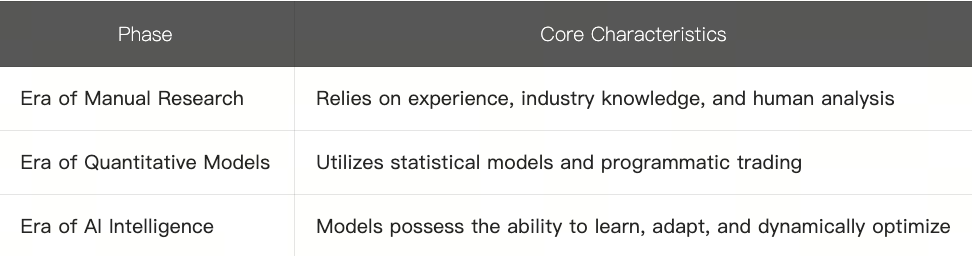
Compared to traditional quantitative methods, the biggest difference with AI lies in its adaptive capabilities
Traditional quantitative models are usually based on rules set in advance by humans, while AI models can continuously train themselves to autonomously discover relationships between data.
For example, some AI systems can now automatically identify:
-
Market style shifts
-
Changes in capital preferences
-
Industry rotation trends
-
Risk event diffusion paths
Future investment systems may no longer just serve as auxiliary tools, but gradually evolve into decision-making systems with autonomous analytical abilities.
Integration of data, algorithms, and financial markets
AI is gradually entering the fields of asset allocation and investment decision-making, with a core reason being: the financial market itself is a highly data-driven system. Whether it's price movements, trading volumes, interest rate changes, corporate financial reports, on-chain activity, or macroeconomic indicators, these are essentially quantifiable information that aligns closely with AI's data analysis strengths.
Compared to traditional manual research methods, AI is better equipped to quickly identify hidden patterns in massive datasets and continuously update its analytical logic. As the scale of market data expands, human analysts find it increasingly difficult to process such vast and complex sources of information, whereas AI's advantage lies in its ability to simultaneously analyze and cross-reference multiple dimensions of data in real time. Structurally, a complete AI financial system typically consists of three core parts: the data layer, the algorithm layer, and the execution layer.
The Data Layer
The primary task of the data layer is to collect, organize, and clean various sources of information, including market data, macroeconomic data, social media and news content, as well as blockchain on-chain data. Since the model relies heavily on input information, data quality directly impacts AI's stability and predictive capabilities. The more complete and timely the data is, the easier it is for the model to generate accurate analytical results.
The Algorithm Layer
The algorithm layer is the core of the entire AI system, responsible for pattern recognition, market forecasting, and strategy analysis. Common technologies include Machine Learning, Deep Learning, Natural Language Processing (NLP), and Reinforcement Learning.
Different algorithms are suited for different applications. For example, Natural Language Processing is more suitable for analyzing news content, social media sentiment, and market mood changes; Reinforcement Learning is often used for dynamic trading strategies because it can continuously adjust behavioral logic based on market feedback. Deep Learning is better suited for handling complex data relationships and nonlinear market changes.
The Execution Layer
Finally, the execution layer is responsible for translating model analysis into actual financial operations, including automated rebalancing, risk management, strategy optimization, and asset reallocation. This layer is crucial because it determines whether AI can truly be implemented. No matter how advanced a model is, if it cannot execute reliably and manage risk effectively, it will ultimately struggle to be applied in real market environments.
Disclaimer
Legal Notice 1: This content does not constitute investment advice. It does not aim to encourage the buying or selling of digital assets and is for informational purposes only. Crypto assets involve high risk and may be subject to significant price volatility. Before making any investment decision, you should assess your own financial situation and make your decision independently.
Legal Notice 2: The data and charts included in this article are provided for general informational purposes only. Although all content has been prepared with care, no responsibility is accepted for any possible errors or omissions. The Gate TR Academy team may translate this content into different languages. No translated article may be copied, reproduced, or distributed without permission.
Catalog
Lesson 1:The New Era of AI and Asset Allocation
1 Enrolled
Lesson 2:Fundamentals of Quantitative Models and Intelligent Investment Systems
0 Enrolled
Lesson 3:Gate AI and Smart Trading Ecosystem in Practice
0 Enrolled
Lesson 4:AI Investment Practices and On-Chain Data Applications
0 Enrolled
Lesson 5:Autonomous Investment Decision Systems and Future Financial Trends
1 Enrolled
Related Courses
Beginner
The Beginner's Guide to Blockchain-based Airdrops
With the rapid development of the blockchain industry, an increasing number of projects choose to hold airdrops to expand their user base and reward early adopters. As a commonly-used marketing strategy, airdrops have not only provided users with opportunities to acquire cryptocurrencies but also offer project teams extensive exposure and the opportunity to expand their communities. Through this course, you will grasp the basic concepts of airdrops, understand different types of airdrop events, and master the skills and strategies for airdrop farming. This way, you will establish a solid foundation for your successful participation in blockchain-based airdrops.
Intermediate
Crypto Mining Equipment
This course covers everything you need to know about mining, from why mining is essential and what is the most helpful mining equipment for the future of crypto mining. We will go into various types of mining analyzing all the equipment like GPUs, CPUs, FPGAs, ASICs

Intermediate
Identity in Crypto: Main Projects
Welcome to the comprehensive course on "Identity in Crypto: Main Projects." In this cutting-edge course, we will embark on a journey to explore the fascinating realm of Identity Tokens within the cryptocurrency ecosystem. As the world embraces blockchain technology and decentralized applications, the importance of secure and verifiable identity solutions becomes paramount. This course will give you in-depth knowledge of Identity Tokens, their significance in the Web3 ecosystem, and their potential to revolutionize identity verification, privacy, and trust. Join us on this enlightening exploration, and equip yourself with the expertise to navigate the dynamic landscape of decentralized identity in the digital age.
Intermediate
Introduction to Masternode Tokens
Welcome to the "Introduction to Masternode Tokens" course! This comprehensive course is designed to provide you with a deep understanding of masternode tokens and their significance in the cryptocurrency ecosystem. Whether you are a beginner or an experienced crypto enthusiast, this course will equip you with the knowledge and skills to navigate the world of masternodes, explore popular masternode-based cryptocurrencies, and explore the fundamental concepts behind masternode networks. Join us on this exciting journey as we delve into the inner workings of masternode tokens and unlock the potential they hold in shaping the future of decentralized finance.
Beginner
Crypto Mining
In this course, you will learn everything you need to know about mining cryptocurrencies, including the different types of mining hardware, software tools, and strategies for reducing the environmental impact of mining. Whether you're a beginner or an experienced miner, this course will provide you with the knowledge and skills to succeed in this exciting and rapidly evolving industry.

Beginner
Learn about web3 data and analytics
In the Web3 Data course, we'll talk about the importance of on-chain data, its uses, and even prospective career paths. You'll also learn about how these analytical tools are created.