

Lesson 4
AI Investment Practices and On-Chain Data Applications
As AI technology continues to mature, the financial markets are entering a new phase of development. AI is no longer just a simple data analysis tool—it is gradually acquiring capabilities in strategy execution and asset management. Especially in the crypto market, the inherent transparency of on-chain data, round-the-clock market operations, and rapid information dissemination make it easier for AI to play a role compared to traditional financial environments. From market analysis and strategy generation to automated execution and fund management, more and more investment processes are being restructured by AI.
The Rise of AI Agents and Autonomous Investment Assistants
Most past AI tools were still passive response systems—in other words, the system would only provide results when users asked questions. However, with the rise of the AI Agent (intelligent agent) concept, AI is evolving from a tool into an active collaborator.
The core features of an AI Agent are that it can not only analyze information but also:
-
Execute tasks autonomously
-
Continuously track market changes
-
Dynamically adjust behavior based on objectives
-
Operate collaboratively with multiple systems
In investment scenarios, this means AI is no longer just providing an analysis report; it may become a long-term "digital investment assistant."
For example, an AI Agent can:
-
Monitor market data in real time
-
Automatically identify trending sectors
-
Analyze on-chain capital flows
-
Assess market risk preferences
-
Generate strategy recommendations
-
Automatically execute operations under specific conditions
The biggest change in this model is that investment processes are shifting from human-driven to system-driven collaboration.
In the future, the relationship between users and AI may shift from using tools to managing intelligent assistants.
On-Chain Data Analysis and Market Behavior Identification
Compared to traditional financial markets, the crypto market has a unique advantage: a vast amount of trading activity, capital flows, and asset changes are publicly traceable.
On-chain data has become an important source of information in the AI investment system. By analyzing on-chain data, AI can observe many market behaviors that traditional finance cannot access in real time, such as:
-
Whale address capital movements
-
Stablecoin inflows and outflows
-
Exchange capital changes
-
Growth trends in new wallets
-
DeFi protocol capital migration
Essentially, this data reflects the behavior of market participants.
For example, when large amounts of stablecoins flow into exchanges, it often signals an increase in market risk appetite; when long-term holding addresses begin to transfer assets on a large scale, it may indicate a shift in market sentiment.
Currently, the application of AI in on-chain analysis mainly focuses on several areas:
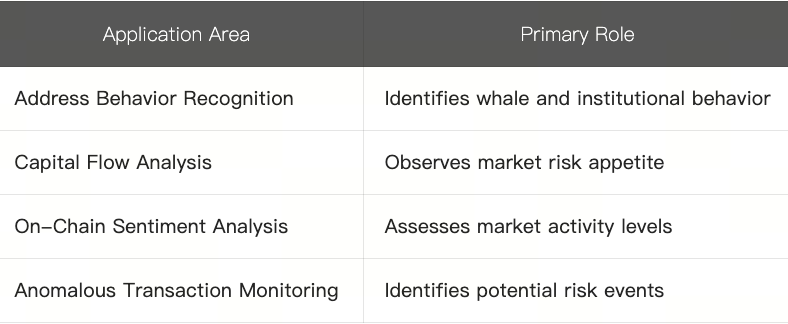
AI-Driven Investment and Market Analysis
As AI models become more advanced, it's likely that AI will further enable:
-
Automatic detection of market manipulation
-
Early identification of trending narratives
-
Dynamic prediction of capital rotation paths
This is why on-chain data combined with AI is considered one of the key competitive directions in the crypto market.
AI-driven Strategy Generation and Portfolio Optimization
With the development of AI technology, investment strategies are gradually shifting from manual design to automated generation. AI models can autonomously generate different types of strategies—trend-following, arbitrage, volatility, or capital rotation—based on market data.
Compared to traditional fixed-rule models, AI's main advantage lies in its ability to continuously adjust strategies according to market conditions. For example, when the market enters a highly volatile phase, the system can automatically reduce exposure to high-risk assets and optimize overall portfolio structure.
In asset portfolio management, AI also takes into account factors such as returns, volatility, asset correlations, and market sentiment, enabling investment portfolios to move from static allocations to real-time dynamic optimization.
From Tool Usage to Intelligent Investment Workflows
The changes AI brings to the investment industry go beyond simply adding a few analysis tools—it's reorganizing the entire investment process. Previously, investing typically required manual information gathering, market analysis, strategy formulation, trade execution, and risk tracking; now, more and more stages are being handled collaboratively by AI.
The intelligent investment workflow of the future may start with information aggregation, where AI automatically organizes news, on-chain data, market sentiment, and macro information, then further analyzes trends, assesses risks, and generates allocation plans based on user objectives. Ultimately, the system can automatically execute trades, rebalance portfolios, and manage risk—continuously optimizing models in response to market changes.
This signals a shift in investment systems from isolated tools to fully integrated intelligent collaboration. In the future, an investor's core competitive edge may no longer be just access to more information—but who can most efficiently leverage and manage AI workflows.
Disclaimer
Legal Notice 1: This content does not constitute investment advice. It does not aim to encourage the buying or selling of digital assets and is for informational purposes only. Crypto assets involve high risk and may be subject to significant price volatility. Before making any investment decision, you should assess your own financial situation and make your decision independently.
Legal Notice 2: The data and charts included in this article are provided for general informational purposes only. Although all content has been prepared with care, no responsibility is accepted for any possible errors or omissions. The Gate TR Academy team may translate this content into different languages. No translated article may be copied, reproduced, or distributed without permission.
Catalog
Lesson 1:The New Era of AI and Asset Allocation
1 Enrolled
Lesson 2:Fundamentals of Quantitative Models and Intelligent Investment Systems
0 Enrolled
Lesson 3:Gate AI and Smart Trading Ecosystem in Practice
0 Enrolled
Lesson 4:AI Investment Practices and On-Chain Data Applications
0 Enrolled
Lesson 5:Autonomous Investment Decision Systems and Future Financial Trends
0 Enrolled
Related Courses
Beginner
The Beginner's Guide to Blockchain-based Airdrops
With the rapid development of the blockchain industry, an increasing number of projects choose to hold airdrops to expand their user base and reward early adopters. As a commonly-used marketing strategy, airdrops have not only provided users with opportunities to acquire cryptocurrencies but also offer project teams extensive exposure and the opportunity to expand their communities. Through this course, you will grasp the basic concepts of airdrops, understand different types of airdrop events, and master the skills and strategies for airdrop farming. This way, you will establish a solid foundation for your successful participation in blockchain-based airdrops.
Intermediate
Crypto Mining Equipment
This course covers everything you need to know about mining, from why mining is essential and what is the most helpful mining equipment for the future of crypto mining. We will go into various types of mining analyzing all the equipment like GPUs, CPUs, FPGAs, ASICs

Intermediate
Identity in Crypto: Main Projects
Welcome to the comprehensive course on "Identity in Crypto: Main Projects." In this cutting-edge course, we will embark on a journey to explore the fascinating realm of Identity Tokens within the cryptocurrency ecosystem. As the world embraces blockchain technology and decentralized applications, the importance of secure and verifiable identity solutions becomes paramount. This course will give you in-depth knowledge of Identity Tokens, their significance in the Web3 ecosystem, and their potential to revolutionize identity verification, privacy, and trust. Join us on this enlightening exploration, and equip yourself with the expertise to navigate the dynamic landscape of decentralized identity in the digital age.
Intermediate
Introduction to Masternode Tokens
Welcome to the "Introduction to Masternode Tokens" course! This comprehensive course is designed to provide you with a deep understanding of masternode tokens and their significance in the cryptocurrency ecosystem. Whether you are a beginner or an experienced crypto enthusiast, this course will equip you with the knowledge and skills to navigate the world of masternodes, explore popular masternode-based cryptocurrencies, and explore the fundamental concepts behind masternode networks. Join us on this exciting journey as we delve into the inner workings of masternode tokens and unlock the potential they hold in shaping the future of decentralized finance.
Beginner
Crypto Mining
In this course, you will learn everything you need to know about mining cryptocurrencies, including the different types of mining hardware, software tools, and strategies for reducing the environmental impact of mining. Whether you're a beginner or an experienced miner, this course will provide you with the knowledge and skills to succeed in this exciting and rapidly evolving industry.

Beginner
Learn about web3 data and analytics
In the Web3 Data course, we'll talk about the importance of on-chain data, its uses, and even prospective career paths. You'll also learn about how these analytical tools are created.