

What Is the New Model for Korean Stock Investing? Exploring Global Asset Allocation Trends Through Gate’s Korean Stock Launch
Last Updated 2026-06-22 12:23:52
In recent years, artificial intelligence, technological innovation, and global capital markets have consistently been investment hotspots. From major U.S. tech companies to Asian growth enterprises, more and more investors are looking for ways to tap into global stock markets. However, traditional cross-border investing often requires opening an overseas brokerage account, exchanging foreign currency, and navigating cumbersome fund transfer processes—a significant barrier for many digital asset users.
As the crypto industry and traditional financial markets increasingly converge, demand for cross-asset investment platforms continues to grow. Gate has officially launched its stock trading service, enabling eligible users to trade directly in major global stock markets using USDT. This initiative gradually builds an integrated investment ecosystem spanning digital assets and traditional financial products, offering a more convenient asset allocation solution for global investors.
What Is Gate Stock Trading?
Gate Stock Trading is a service that lets you buy and sell stocks and ETFs directly on the Gate platform. Unlike traditional cross-border securities investing, you don't need to open an extra traditional brokerage account or exchange USD, HKD, or KRW yourself. Instead, you can participate in major global stock markets using USDT.
Gate's stock service is not the common tokenized stock or RWA mapped asset model. The platform prioritizes market access capabilities and compliant trading architecture by connecting with regulated brokers to provide actual stock and ETF trading—not on-chain mapped assets or tokenized derivatives. This model allows you to invest in a way closer to traditional securities markets while retaining the advantages of digital asset platforms in fund management and operational convenience.
How Does Gate Bridge Digital Assets and Traditional Financial Markets?
Previously, crypto investing and stock investing typically belonged on separate platforms, requiring you to manage exchange accounts, securities accounts, and multiple currency funds—increasing the complexity of asset management. Gate, through its unified account structure, shortens the distance between these two markets. On a single platform, you can manage both digital assets and stock holdings, execute trades, check positions, view profit and loss statistics, review fund flows, and handle corporate actions. The integrated interface allows you to efficiently grasp your overall asset picture, reducing friction from cross-platform operations. This one-stop management approach also reflects the global financial market's gradual shift toward multi-asset integration.
Which Stock Markets Does Gate Currently Support?
While stock products continue to expand, Gate has built a global stock market footprint covering U.S., Hong Kong, and South Korean equities.
U.S. Stock Market
The platform now supports over 10,000 U.S. stocks and ETFs, covering major U.S. exchanges and liquidity networks, including Nasdaq, NYSE, NYSE Arca, NYSE American, and BATS. This gives you access to investment opportunities in global technology, finance, consumer, and industrial leaders, as well as a diverse range of thematic and sector-based ETF products.
Hong Kong Stock Market
In the Hong Kong market, Gate supports over 1,500 Hong Kong stock targets. The Hong Kong market hosts a large number of representative Asian and Chinese companies across diverse sectors such as technology, finance, telecommunications, insurance, and new energy. On a single platform, you can access different industries and regional markets, further enhancing asset allocation flexibility. The inclusion of Hong Kong stocks also allows you to participate in the development of Asia's important capital markets alongside U.S. stocks.
South Korea Stock Market
As the latest market to launch, Gate has officially opened South Korean stock trading, further expanding its global stock reach. You can now directly trade companies listed on the Korea Exchange (KRX) using USDT, without needing to open a local Korean brokerage account or exchange KRW yourself.
The initial batch of targets covers the top 1,000 listed companies by market capitalization on the Korea Exchange, including:
- KOSPI Main Board
- KOSDAQ Market
South Korea's capital market holds strong positions in semiconductors, artificial intelligence, automotive manufacturing, consumer electronics, and advanced manufacturing, attracting significant global investor interest.
With the addition of South Korean stocks, Gate now has a core stock market layout spanning the Americas and Asia.
How Does South Korea Stock Trading Time Differ from U.S. and Hong Kong Stocks?
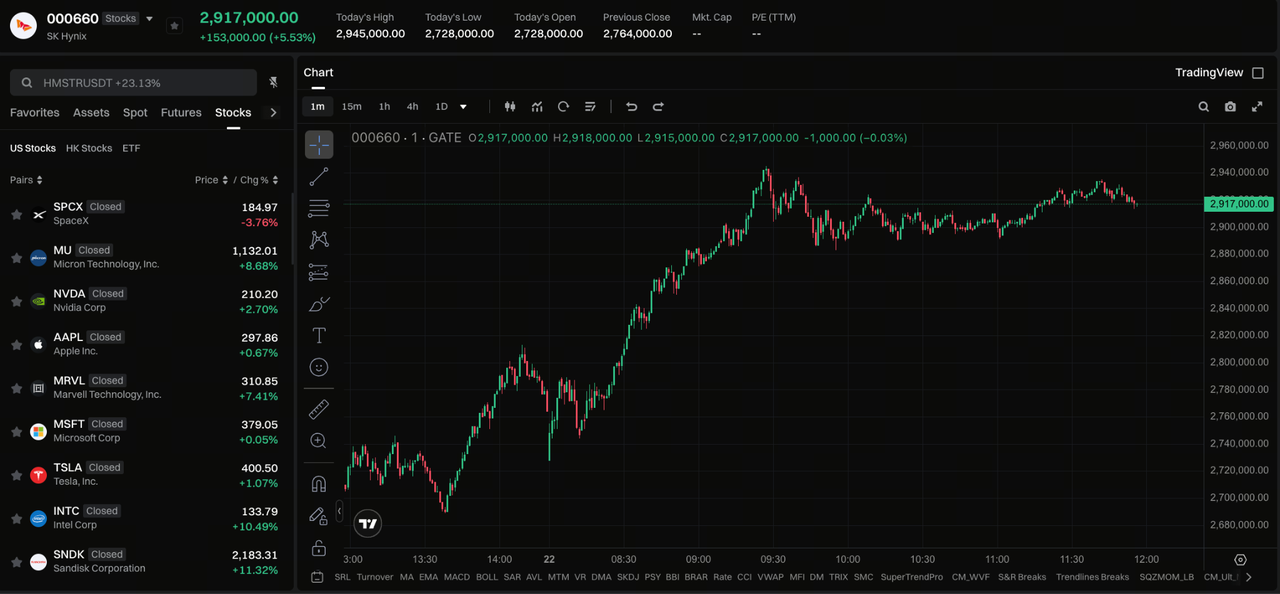
For those planning to participate in the South Korean capital market, understanding the trading hours and market rules for Korean stocks is essential. Gate's current South Korean stock trading service uses a continuous auction mechanism consistent with the Korea Exchange (KRX) and does not currently support pre-market or after-hours sessions. You can trade during normal Korean market hours. On Korean public holidays or temporary market closures, please refer to official announcements from KRX and Gate.
Apart from differences in trading hours, Korean stocks also differ from U.S. and Hong Kong stocks in market mechanisms. The U.S. stock market typically supports multiple sessions—pre-market, regular, and after-hours—allowing timely trading after earnings reports or major announcements. Korean stocks currently only support continuous auction during regular hours, with liquidity mainly concentrated in the normal trading session.
Regarding pricing, Korean stocks are denominated in South Korean Won (KRW). Stock prices, position market values, and profit/loss information are all displayed in KRW. However, you can still transfer funds and trade using USDT, with related fees and settlement converted to USDT at real-time exchange rates—no need to exchange KRW yourself.
Although markets differ in trading hours and quote currencies, on the Gate platform, U.S., Hong Kong, and South Korean stocks all use a unified stock account structure. Through a single interface, you can execute trades, manage positions, view profit and loss statistics, and check history, enabling more efficient management of global stock assets.
What Are the Advantages of Trading Stocks with USDT?
For many digital asset users, the biggest change is a dramatic simplification of the investment process.
Traditional cross-border investing typically involves the following steps:
- Open an overseas brokerage account
- Make a bank wire transfer
- Exchange foreign currency
- Wait for funds to arrive
- Start trading
With Gate's stock service, you only need to transfer USDT to your stock account to directly participate in the stock market. This model greatly reduces conversion costs between different markets and makes it easier for users familiar with digital asset operations to engage in global stock markets. Meanwhile, stock prices, market values, and profit/loss are still displayed in each market's local currency—for example, Korean stocks in KRW—while trading fees and settlement are converted to USDT at real-time exchange rates, balancing investment experience and operational convenience.
How Does Fractional Share Trading Lower the Investment Threshold?
Beyond more convenient fund usage, Gate also supports fractional share trading with a minimum of 0.01 shares. In traditional stock investing, some well-known companies have high share prices, requiring significant capital to establish a position. Fractional shares let you allocate flexibly according to your own funds, enabling participation in large global companies or popular ETFs even with limited capital. For novice users new to global stock markets, fractional shares help gradually build an investment portfolio, reducing the pressure of a large one-time investment.
What Features Does Gate Stock Trading Offer?
In addition to expanding market coverage, the platform provides a wealth of trading and management features. U.S. stock products already support pre-market and after-hours trading, extending trading hours to 16×5, allowing you to respond promptly to market events such as corporate earnings, major announcements, and economic data releases. The unified account structure enables centralized management of various stock positions and digital assets, letting you view position information, fund flows, profit and loss statistics, corporate actions, and historical trading data at any time. These features improve asset management efficiency, making the cross-market investment experience more seamless. Additionally, stock products have been incorporated into the platform's VIP tier system, allowing you to enjoy corresponding trading fee rates and service benefits based on your eligibility, further optimizing the investment experience.
What Does the Global Stock Market Layout Represent?
The successive launches of U.S., Hong Kong, and South Korean stock markets show that Gate is building a global stock product matrix. This not only means expanding market coverage but also reflects the blurring boundaries between digital asset platforms and traditional financial markets. When you want to allocate simultaneously to cryptocurrencies, tech stocks, ETFs, or Asian growth enterprises, the importance of a multi-asset integrated platform increases. With a unified account, USDT settlement, and global market access capabilities, Gate aims to deliver a more complete cross-market investment experience, allowing digital assets and traditional financial products to work together within the same ecosystem.
Visit the Korean Stock Trading Zone now to start your global investment journey:
-
Web: Stocks - Korea Stocks
-
App: TradFi - Stocks - Market - Korea Stocks (requires update to v8.25.0 or above)
Summary
The launch of Gate Stock Trading marks the platform's expansion from digital assets to major global securities markets. You can directly trade U.S., Hong Kong, and South Korean stocks using USDT, without needing to open an additional traditional brokerage account or exchange foreign currency yourself, enabling cross-market asset allocation. With over 11,500 stocks and ETFs, fractional share trading, a unified account structure, and expanding global market coverage, Gate is gradually building a one-stop investment platform that integrates digital assets and traditional financial products. In the future, as more markets and asset classes come online, global investors will be able to participate in global capital market development with lower barriers and higher efficiency.
FAQ
- How is Gate Stock Trading different from tokenized stocks?
Gate Stock Trading is not a tokenized stock or RWA mapped asset model. Instead, it provides stock and ETF trading services by connecting with regulated brokers, emphasizing market access capabilities and compliant trading frameworks.
- Do I need to open an overseas brokerage account to use Gate Stock Trading?
No. Eligible users can directly trade stocks on the Gate platform using USDT, without opening an additional traditional brokerage account or exchanging foreign currency themselves.
- Which markets does Gate Stock Trading currently support?
It currently supports the U.S. stock market, Hong Kong stock market, and South Korea stock market, covering over 10,000 U.S. stocks and ETFs, over 1,500 Hong Kong stocks, and the top 1,000 listed companies by market capitalization on the Korea Exchange (KRX).
Author: Allen
Disclaimer
* Legal Notice 1: This content does not constitute investment advice. It is not intended to promote the buying/selling of digital assets and is for informational purposes only. Crypto assets carry high risks and may be subject to significant price fluctuations. Before making any investment decision, you should assess your own financial situation and make an independent decision.
* Legal Notice 2: The data and charts provided in the article are for general informational purposes only. Although all content is carefully prepared, no responsibility is accepted for possible errors or omissions. The Gate TR Learn team may translate this content into different languages. No translated article may be copied, reproduced, or distributed without permission.
Share
Content
What Is Gate Stock Trading?
How Does Gate Bridge Digital Assets and Traditional Financial Markets?
Which Stock Markets Does Gate Currently Support?
How Does South Korea Stock Trading Time Differ from U.S. and Hong Kong Stocks?
What Are the Advantages of Trading Stocks with USDT?
How Does Fractional Share Trading Lower the Investment Threshold?
What Features Does Gate Stock Trading Offer?
What Does the Global Stock Market Layout Represent?
Summary
FAQ


Sign Up
Related Articles

Beginner
The Future of Cross-Chain Bridges: Full-Chain Interoperability Becomes Inevitable, Liquidity Bridges Will Decline
This article explores the development trends, applications, and prospects of cross-chain bridges.
2026-04-08 17:11:27

Advanced
Solana Need L2s And Appchains?
Solana faces both opportunities and challenges in its development. Recently, severe network congestion has led to a high transaction failure rate and increased fees. Consequently, some have suggested using Layer 2 and appchain technologies to address this issue. This article explores the feasibility of this strategy.
2026-04-06 23:31:03

Intermediate
Sui: How are users leveraging its speed, security, & scalability?
Sui is a PoS L1 blockchain with a novel architecture whose object-centric model enables parallelization of transactions through verifier level scaling. In this research paper the unique features of the Sui blockchain will be introduced, the economic prospects of SUI tokens will be presented, and it will be explained how investors can learn about which dApps are driving the use of the chain through the Sui application campaign.
2026-04-07 01:11:45

Advanced
Navigating the Zero Knowledge Landscape
This article introduces the technical principles, framework, and applications of Zero-Knowledge (ZK) technology, covering aspects from privacy, identity (ID), decentralized exchanges (DEX), to oracles.
2026-04-08 15:08:18

Beginner
What is Tronscan and How Can You Use it in 2025?
Tronscan is a blockchain explorer that goes beyond the basics, offering wallet management, token tracking, smart contract insights, and governance participation. By 2025, it has evolved with enhanced security features, expanded analytics, cross-chain integration, and improved mobile experience. The platform now includes advanced biometric authentication, real-time transaction monitoring, and a comprehensive DeFi dashboard. Developers benefit from AI-powered smart contract analysis and improved testing environments, while users enjoy a unified multi-chain portfolio view and gesture-based navigation on mobile devices.
2026-03-24 11:52:42

Beginner
What Is a Yield Aggregator?
Yield Aggregators are protocols that automate the process of yield farming which allows crypto investors to earn passive income via smart contracts.
2026-04-09 06:13:50