

What Is Cap (CAP)? A Comprehensive Guide to Its Principles, Mechanisms, and Ecosystem
Last Updated 2026-06-24 06:22:41
As the stablecoin market continues to grow, on-chain users face a persistent issue: liquidity fragmentation. Isolated liquidity pools have spread across different stablecoin issuers, blockchains, and yield protocols, making it difficult for users to strike a balance between security, yield, and liquidity.
Meanwhile, the evolution of on-chain yield markets has introduced fresh challenges. Yield sources are becoming more complex, and the relationships among risk takers, yield seekers, and protocol operators are growing tighter. Establishing transparent, scalable coordination mechanisms has become a top industry priority.
Cap's design was born from this context. With a unified stablecoin layer and yield layer architecture, it aims to offer users a more efficient way to manage on-chain dollar assets.
What is Cap
Cap is an infrastructure protocol centered on stablecoin aggregation and the yield market. It connects stablecoin assets, capital seekers, and on-chain applications through a unified liquidity layer, yield market, and shared security framework.
Cap issues cUSD as its unified stablecoin and introduces yield-bearing assets like stcUSD, allowing users to capture on-chain yield while maintaining dollar exposure.
Positioned at the intersection of stablecoin infrastructure, yield protocols, and shared security networks, Cap's core strength lies in integrating stablecoin aggregation, yield distribution, and risk buffering into a single protocol framework.
How Cap Tackles Stablecoin Fragmentation and Yield Risk
Stablecoin markets have long suffered from asset fragmentation. While USDC, USDT, DAI, and others target the dollar, they differ in liquidity, use cases, and risk profiles.
Cap aims to build a unified stablecoin gateway via cUSD, so users can participate across the ecosystem without constant swaps between stablecoins.
Yield markets also face uneven risk distribution. Some participants chase yield, others bear systemic risk, often without transparent coordination. By introducing dedicated risk-bearing and yield distribution layers, Cap seeks to create a more structured yield market.
How Cap's Three-Party Market Structure Works
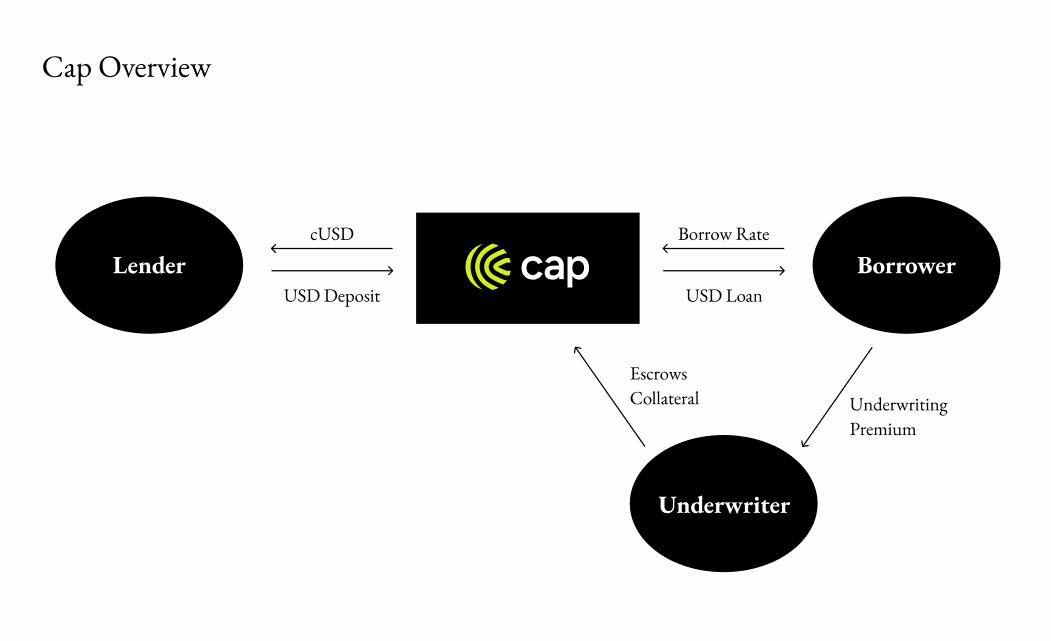
Cap's protocol architecture can be seen as a market comprising asset providers, yield participants, and risk takers.
Asset providers deposit stablecoins into the protocol and receive asset certificates like cUSD. Yield participants generate protocol yield by holding yield-bearing assets. Risk takers provide additional safeguards through Delegation or similar security mechanisms and earn corresponding incentives.
This design enables clearer allocation of yield and risk among participants.
| Participant Role | Primary Responsibility | Value Received |
|---|---|---|
| Asset Provider | Provides stablecoin liquidity | cUSD |
| Yield Participant | Participates in yield market | stcUSD yield |
| Risk Taker | Provides security guarantees | Incentive rewards |
Roles of cUSD and stcUSD in the Protocol
cUSD is the core stablecoin in the Cap ecosystem, aggregating underlying stablecoin reserves and facilitating value transfer. It aims to become the protocol's unified dollar-denominated unit, reducing complexity from multiple stablecoins.
stcUSD is a yield-bearing asset built on cUSD, separating yield rights from the underlying asset.
This design allows users to choose different asset forms based on risk preference.
cUSD emphasizes liquidity and stability, while stcUSD focuses on yield generation.
How Vault, Lender, and Fee Auction Work Together
The Vault manages protocol asset reserves, handling stablecoin storage, minting, and redemption.
The Lender provides funding for the yield market and helps establish a capital-efficient fund structure.
The Fee Auction handles fee discovery and resource allocation, using market mechanisms to determine protocol resource efficiency.
Together, they form Cap's core operational framework: the Vault provides the asset base, the Lender supplies capital, and the Fee Auction enables market-driven coordination, completing the economic cycle.
How Delegation and Shared Security Networks Provide Protection
Cap introduces Delegation, allowing participants to provide additional risk buffer capacity.
The essence of Delegation is to create a new coordination relationship between yield and risk, giving the system greater security redundancy.
Shared Security Networks extend this idea further, pooling security resources to enhance overall protocol resilience.
Cap's security model combines market incentives and risk-bearing structures rather than relying solely on a single collateral mechanism.
This design helps the protocol remain stable in complex market environments.
Role of the CAP Token in Governance and Protocol Integration
CAP is the core governance asset in the protocol ecosystem.
CAP holders participate in protocol governance, including parameter adjustments, module upgrades, and ecosystem direction. Beyond governance, CAP supports ecosystem coordination.
As protocol integration expands, CAP is expected to play a greater role in incentive distribution, ecosystem collaboration, and governance coordination.
CAP's value stems more from governance rights and ecosystem participation rights than from a simple payment function.
What Are the Main Use Cases of Cap
Cap's use cases center on stablecoin asset management.
For users managing multiple stablecoins, cUSD provides a standardized on-ramp. Yield management is another key scenario—users can participate through assets like stcUSD. Institutional fund management, on-chain dollar settlements, and cross-protocol liquidity management are also potential applications.
As the ecosystem grows, Cap could become a key infrastructure linking the stablecoin market and on-chain yield market.
Cap's Advantages and Limitations
Cap's advantages include a unified stablecoin gateway, structured yield design, and shared security mechanisms.
By aggregating liquidity and coordinating the yield market, Cap reduces complexity for users juggling multiple protocols. However, its operation relies on multiple layers—asset management, yield distribution, and security networks. This complexity enhances functionality but raises the learning curve.
Like most emerging protocols, Cap's long-term success depends on adoption, liquidity scale, and the continued evolution of its governance mechanism.
Summary
Cap is an on-chain protocol ecosystem built around stablecoin aggregation, yield management, and risk coordination. It establishes base and yield asset layers through cUSD and stcUSD, and uses modules like Vault, Lender, Fee Auction, Delegation, and Shared Security Networks for fund management, yield distribution, and security. For those focused on on-chain dollar asset management and yield market development, Cap offers a more structured approach.
FAQ
What is Cap (CAP)?
Cap is an on-chain protocol focused on stablecoin aggregation and the yield market, connecting liquidity, yield, and risk management through cUSD, stcUSD, and a multi-layer security framework.
How does Cap's cUSD work?
cUSD is the unified stablecoin in the Cap ecosystem, backed by protocol reserves. It aggregates different stablecoin liquidity and serves as the protocol's base unit of account.
What is the difference between cUSD and stcUSD?
cUSD focuses on stable value and liquidity, while stcUSD represents yield rights on top of the underlying asset. They cater to different user needs.
What are the main use cases of Cap?
Cap supports stablecoin management, on-chain dollar allocation, yield generation, liquidity coordination, and institutional fund management.
What is the role of the CAP token?
The CAP token is primarily used for protocol governance, ecosystem coordination, and managing key parameters. Holders participate in protocol direction and governance decisions.
Author: Carlton
Disclaimer
* Legal Notice 1: This content does not constitute investment advice. It is not intended to promote the buying/selling of digital assets and is for informational purposes only. Crypto assets carry high risks and may be subject to significant price fluctuations. Before making any investment decision, you should assess your own financial situation and make an independent decision.
* Legal Notice 2: The data and charts provided in the article are for general informational purposes only. Although all content is carefully prepared, no responsibility is accepted for possible errors or omissions. The Gate TR Learn team may translate this content into different languages. No translated article may be copied, reproduced, or distributed without permission.
Share
Content
What is Cap
How Cap Tackles Stablecoin Fragmentation and Yield Risk
How Cap's Three-Party Market Structure Works
Roles of cUSD and stcUSD in the Protocol
How Vault, Lender, and Fee Auction Work Together
How Delegation and Shared Security Networks Provide Protection
Role of the CAP Token in Governance and Protocol Integration
What Are the Main Use Cases of Cap
Cap's Advantages and Limitations
Summary


Sign Up
Related Articles

Beginner
In-depth Explanation of Yala: Building a Modular DeFi Yield Aggregator with $YU Stablecoin as a Medium
Yala inherits the security and decentralization of Bitcoin while using a modular protocol framework with the $YU stablecoin as a medium of exchange and store of value. It seamlessly connects Bitcoin with major ecosystems, allowing Bitcoin holders to earn yield from various DeFi protocols.
2026-03-24 11:55:44

Intermediate
Sui: How are users leveraging its speed, security, & scalability?
Sui is a PoS L1 blockchain with a novel architecture whose object-centric model enables parallelization of transactions through verifier level scaling. In this research paper the unique features of the Sui blockchain will be introduced, the economic prospects of SUI tokens will be presented, and it will be explained how investors can learn about which dApps are driving the use of the chain through the Sui application campaign.
2026-04-07 01:11:45

Beginner
What Is a Yield Aggregator?
Yield Aggregators are protocols that automate the process of yield farming which allows crypto investors to earn passive income via smart contracts.
2026-04-09 06:13:50

Intermediate
Dive into Hyperliquid
Hyperliquid's vision is to develop an on-chain open financial system. At the core of this ecosystem is Hyperliquid L1, where every interaction, whether an order, cancellation, or settlement, is executed on-chain. Hyperliquid excels in product and marketing and has no external investors. With the launch of its second season points program, more and more people are becoming enthusiastic about on-chain trading. Hyperliquid has expanded from a trading product to building its own ecosystem.
2026-04-07 00:06:09

Beginner
What is Stablecoin?
A stablecoin is a cryptocurrency with a stable price, which is often pegged to a legal tender in the real world. Take USDT, currently the most commonly used stablecoin, for example, USDT is pegged to the US dollar, with 1 USDT = 1 USD.
2026-04-09 10:16:21

Beginner
Arweave: Capturing Market Opportunity with AO Computer
Decentralised storage, exemplified by peer-to-peer networks, creates a global, trustless, and immutable hard drive. Arweave, a leader in this space, offers cost-efficient solutions ensuring permanence, immutability, and censorship resistance, essential for the growing needs of NFTs and dApps.
2026-04-07 02:30:19