

Buy Microsoft Stock on Gate: How Is It Different from Buying Through a Traditional Broker?
Last Updated 2026-06-18 10:20:17
Microsoft is one of the most widely followed U.S.-listed technology companies, with business lines across cloud computing, productivity software, enterprise services, gaming, and AI-related infrastructure. For crypto-native users, Microsoft Stock (MSFT) is often viewed through a different operational lens: not only as a U.S. equity, but also as an asset that may be accessed through USDT-based stock trading products.
Gate Stocks connects eligible users with U.S. stock exposure inside a Gate account environment. This structure can make stock access more direct for users who already hold USDT, but it also requires a clear understanding of product mechanics, dividend processing, shareholder rights, transfer rules, price differences, and risk controls.
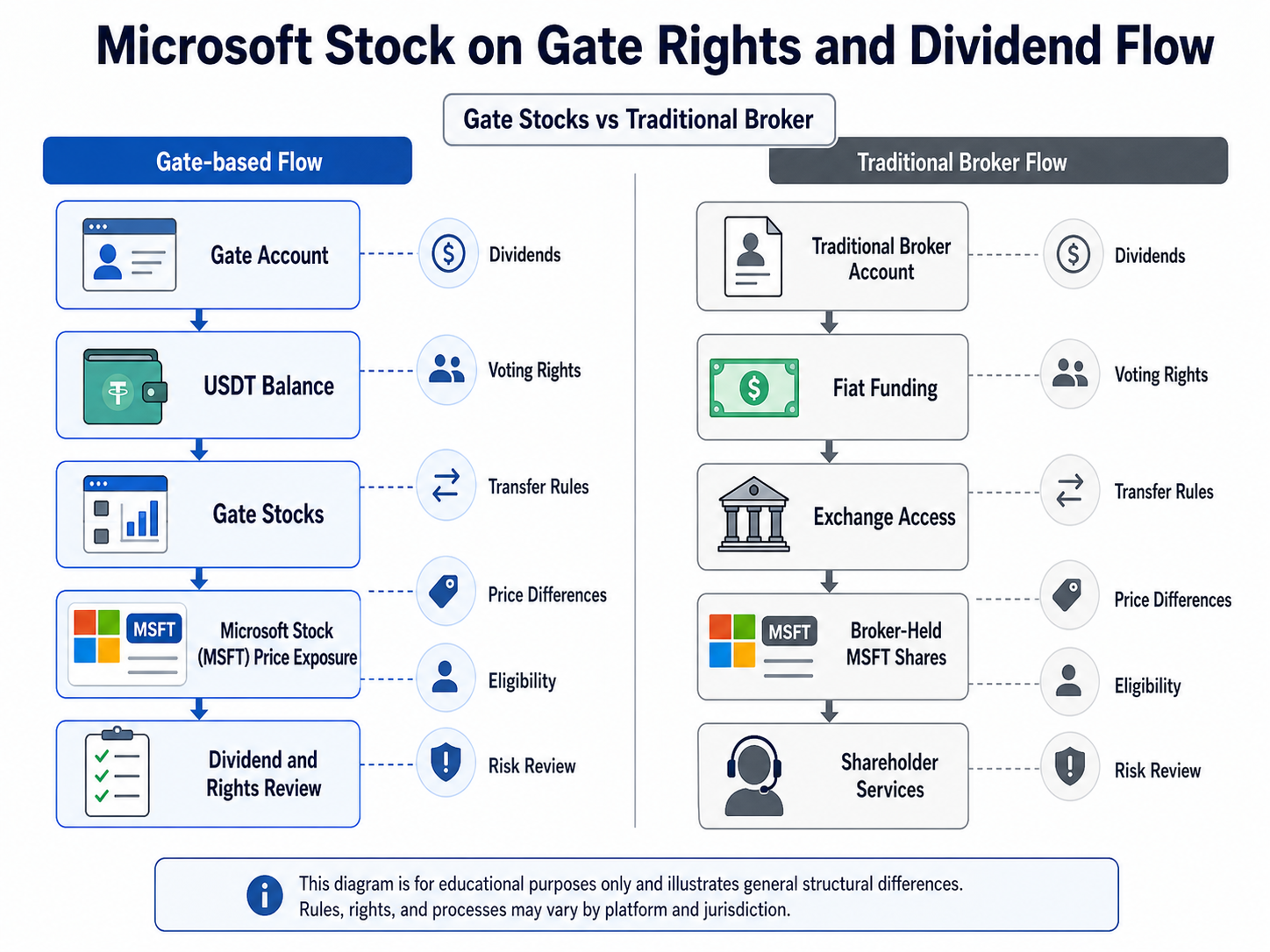
What Is the Key Difference Between Buying Microsoft Stock on Gate and Buying It Through a Traditional Broker?
The key difference between buying Microsoft Stock (MSFT) on Gate and buying it through a traditional broker lies in the account structure, settlement asset, product rules, and shareholder-rights framework. Gate Stocks gives eligible users price exposure to Microsoft Stock through Gate’s stock trading product structure. A traditional broker usually gives users brokerage-based access to securities markets through a securities account, fiat funding rails, broker custody arrangements, and shareholder-service infrastructure.
For users who already hold USDT, Gate Stocks trading creates a different operating flow. Instead of moving funds from a crypto account to a bank and then into a brokerage account, users may fund the stock account with USDT, search for Microsoft Stock (MSFT), review order information, and place an order if the product is available to their account and region as of June 2026.
This difference does not mean one route is automatically more suitable than the other. Gate Stocks may fit users who prefer a crypto-native settlement environment. A traditional broker may fit users who need direct brokerage documentation, registered shareholder services, tax forms, transfer options, or governance participation. The correct comparison is not only about access. It is about what rights, records, and operational controls the user needs.
| Preparation item | What to check before buying Microsoft Stock (MSFT) on Gate |
|---|---|
| Stock name and ticker | Confirm Microsoft Stock (MSFT), not a fund, CFD, derivative, or similarly named asset |
| Product type | Confirm the product is Gate Stocks price exposure under current Gate product rules |
| Settlement asset | Check whether the order is funded and settled in USDT as of June 2026 |
| Dividend rule verification | Review current dividend processing rules before trading |
| Voting rights verification | Confirm whether voting rights apply under the latest rights structure |
| Transfer rule verification | Check whether external broker transfer or stock withdrawal is supported |
| Regional eligibility | Confirm product access based on account status, verification, and location |
| Risk review | Review market, platform, stablecoin, price-difference, and product-structure risks |
These preparation points matter because buying Microsoft Stock (MSFT) through Gate Stocks is not only an order-placement action. It is also a product-structure decision. Users should understand the funding path, the rights framework, and the records available in the account before comparing it with traditional brokerage ownership.
How Are Dividends Handled When Buying Microsoft Stock on Gate?
Dividend handling is one of the most important questions for users buying Microsoft Stock (MSFT) on Gate. Microsoft has historically been associated with cash dividends, but the practical treatment of any dividend through Gate Stocks depends on Gate’s current product rules, corporate action processing, account eligibility, timing, and supported records as of June 2026. Users should not assume that dividend treatment is identical to direct broker-held shares unless current Gate documentation clearly confirms the same outcome.
Within the Gate Stocks structure, cash-based economic benefits are generally handled inside the stock account framework and may be credited in USDT when supported under the applicable rules as of June 2026. Users can review product records, transaction history, and dividend-related entries where available. However, dividend eligibility, payment timing, processing currency, tax treatment, and corporate action handling may depend on the product rules in effect at the relevant record date.
The distinction between economic rights and shareholder rights is central. Economic rights relate to financial outcomes such as supported cash dividends, stock dividends, splits, reverse splits, or other corporate action adjustments. Shareholder rights relate to governance participation, registered shareholder status, voting, and similar company-level rights. The difference is covered more broadly in the Gate Stocks explanation of stock economic rights and shareholder rights.
Dividend handling should be verified from Gate’s latest official product rules before trading. A user who specifically needs dividend statements, tax records, withholding details, or broker-style dividend documentation should compare Gate Stocks records with what a traditional broker provides before choosing a route.
Do Users Holding Microsoft Stock on Gate Have Shareholder Voting Rights?
Users holding Microsoft Stock (MSFT) on Gate should not assume they receive the same shareholder voting rights as users who hold Microsoft shares through a traditional brokerage account with registered shareholder-service access. As of June 2026, Gate Stocks users generally need to distinguish between price exposure and economic benefits on one side, and governance-related shareholder rights on the other side.
Voting rights usually depend on how shares are held, how ownership is registered, how shareholder materials are distributed, and whether the user is recognized within the applicable securities registration or proxy-voting system. Gate Stocks uses a product structure that differs from a traditional broker account. For that reason, shareholder meeting voting, participation in shareholder proposals, rights election choices, and other governance-related privileges may not be available in the same way as direct brokerage-held shares.
This point is especially important for users who care about corporate governance. Microsoft shareholders may vote on certain company matters through traditional shareholder channels, but Gate Stocks access should be evaluated based on Gate’s current product rules. The user should confirm the latest rights structure inside Gate before assuming any voting entitlement.
For most users, the practical question is whether the main objective is price exposure and supported economic benefits, or direct shareholder participation. If the user wants MSFT price exposure with USDT settlement, Gate Stocks may match that operational need. If the user needs proxy voting, formal shareholder communications, or full traditional shareholder services, a traditional broker may be more suitable.
Why May Gate’s Microsoft Stock Price Differ from the Exchange Price?
Gate’s Microsoft Stock (MSFT) price may differ from a live exchange quote because product structure, liquidity, execution timing, spreads, market session availability, reference pricing, and order processing can all affect the displayed and executed price. A user should review the order page before confirmation rather than assuming that the first quote seen on the screen will be the final execution price.
Traditional brokers and Gate Stocks can both reflect U.S. market movements, but they may show differences at specific moments. The difference may be more visible during fast-moving sessions, near market open or close, during earnings-related volatility, around major macroeconomic announcements, or when liquidity changes. If pre-market or after-hours access is available for certain users and products as of June 2026, the reference price and available liquidity may also differ from regular-session exchange quotes.
Spreads are another practical factor. A buy quote and a sell quote may not be identical, and the gap between them may widen when market conditions are less stable. Order type also matters. A market order prioritizes execution, while a limit order may provide more price control if available in the current interface.
Users comparing Gate Stocks with traditional brokerage access should also understand how Gate Stocks, traditional brokers, and stock CFDs differ. Price exposure through a stock trading product is not the same as trading a leveraged derivative or holding shares through every broker service. Before placing an order, users should check the displayed price, estimated quantity, USDT amount, fees, order type, trading session, and final confirmation details.
Can Users Transfer Microsoft Stock from Gate to Another Broker?
Users should not assume that Microsoft Stock (MSFT) positions held through Gate Stocks can be transferred to an external brokerage account unless Gate’s official product rules clearly support such transfers as of June 2026. Transfer rules are a major difference between a stock access product and a traditional brokerage account.
In a traditional brokerage structure, users may have access to broker-to-broker transfers, account statements, cost-basis records, securities custody details, and other administrative services depending on the broker and market. Gate Stocks follows a different product and account framework. Users may be able to buy, hold, sell, and review transaction records inside the Gate environment, but that does not automatically mean the position can be withdrawn as stock or moved into another broker account.
This distinction matters before the trade, not only after the trade. A user who plans to consolidate all holdings at a broker, transfer MSFT shares for estate planning, use broker-specific tax records, or participate in direct shareholder services should confirm whether Gate Stocks supports that exact requirement. If transfer support is not clearly shown in the current rules, the safer assumption is that Gate Stocks should be treated as an in-platform stock exposure and account-record product.
A practical review should include three questions. Can the position be sold for USDT inside Gate? Can the stock position be externally transferred? Can the user obtain the specific records needed for accounting, tax, or reporting? These answers may differ across products and over time, so users should verify the latest transfer and product rules before trading.
When Is Buying Microsoft Stock on Gate More Suitable, and When Is a Traditional Broker More Suitable?
Buying Microsoft Stock (MSFT) on Gate may be more suitable for users who already hold USDT, want stock price exposure inside a Gate account, prefer a crypto-native settlement flow, and are comfortable reviewing Gate Stocks product rules before trading. It may also suit users who want a simplified path from digital assets to supported U.S. stock exposure without separately opening a traditional overseas brokerage account, subject to eligibility and product availability as of June 2026.
Traditional brokers may be more suitable for users who need a full securities account, formal broker statements, direct exchange-based share custody arrangements, broader tax-document workflows, shareholder voting participation, transfer options, and a wider set of stock-market tools. A broker may also be preferable when the user needs margin features, advanced research tools, retirement-account structures, broker-to-broker transfer flexibility, or jurisdiction-specific reporting documents.
The difference becomes clearer when users compare buying U.S. stocks with USDT on Gate with traditional brokerage funding. Gate Stocks centers on USDT settlement and a Gate account structure. Traditional brokers usually center on fiat funding, securities custody, and broker-specific reporting.
| Dimension | Buying Microsoft Stock on Gate | Buying Microsoft through a traditional broker |
|---|---|---|
| Access method | Gate account and Gate Stocks access, subject to eligibility | Brokerage account and securities onboarding |
| Price exposure | Microsoft Stock (MSFT) price exposure through Gate Stocks | Direct brokerage-based market exposure |
| Settlement asset | Typically USDT under Gate Stocks rules as of June 2026 | Usually fiat currency such as USD |
| Dividend handling | Processed according to Gate Stocks rules and account records | Processed through broker and securities infrastructure |
| Voting rights | Generally not the same as registered shareholder voting | Usually supported depending on broker and shareholding structure |
| Transfer options | Should not be assumed unless current Gate rules support it | Often available through broker transfer systems |
| Trading hours | Depends on Gate product status and supported sessions | Depends on broker and market access |
| Records | Gate account and stock account transaction records | Broker statements, tax documents, and custody records |
| Product-rule dependency | High, users must check Gate’s latest rules | Depends on broker terms and market rules |
| Risk profile | Market, USDT, product-structure, platform, and eligibility risks | Market, broker, custody, tax, and regulatory risks |
The comparison shows that the choice is mainly about user needs. Gate Stocks may be operationally convenient for users who manage assets in USDT. A traditional broker may be more appropriate when the user needs a complete securities-account framework, shareholder services, and external transfer flexibility.
What Risks Should Users Understand Before Buying Microsoft Stock on Gate?
Buying Microsoft Stock (MSFT) on Gate involves market risk. Microsoft’s share price can rise or fall because of earnings, cloud growth, AI infrastructure spending, software demand, competition, regulatory issues, interest-rate expectations, sector rotation, or broader U.S. equity-market conditions. Access through Gate Stocks does not reduce the underlying volatility of MSFT or remove the possibility of loss.
Product-structure risk is also important. Gate Stocks gives users a way to access stock price exposure through Gate’s product framework, but users should not treat every feature as identical to a traditional brokerage account. Dividend processing, voting rights, corporate action treatment, transfer rules, statements, eligibility, and account records can differ as of June 2026.
Liquidity and price-difference risk should be reviewed before every order. Displayed prices, execution prices, spreads, available sessions, and order outcomes may change quickly. Market orders can fill at a different price from the first visible quote. Limit orders may not fill if the market does not reach the selected price or if product rules restrict execution.
Stablecoin-related risk applies when USDT is used as the funding and settlement asset. USDT is designed to track the U.S. dollar, but stablecoins can involve liquidity, redemption, reserve, counterparty, regulatory, and operational risks. Users should also consider platform risk, account security, regional eligibility, product availability, tax-record needs, and the risk of misunderstanding dividend or shareholder-rights treatment.
The broader context of USDT stock trading without a brokerage account is useful because convenience and product simplicity should not be confused with lower risk. Users should confirm the current Gate Stocks interface, product notices, order page, fee display, and rights documentation before placing a Microsoft Stock (MSFT) order.
Summary
Buying Microsoft Stock (MSFT) on Gate gives eligible users real price exposure to Microsoft through the Gate Stocks product structure, with USDT used as the main funding and settlement asset as of June 2026. This creates a different experience from traditional brokerage investing, especially in account setup, settlement flow, product-rule dependency, dividend processing, shareholder rights, transfer options, and recordkeeping.
Dividend handling should be checked from Gate’s latest product rules before trading. Cash-based economic benefits may be reflected through the Gate Stocks account framework when supported, but users should not assume that dividend treatment, tax documentation, or shareholder services are identical to traditional broker-held shares.
Voting rights and transfer options require special attention. Gate Stocks users generally should not assume traditional shareholder voting rights or external broker transfers unless current product rules clearly support them. For users focused mainly on USDT-based MSFT price exposure, Gate Stocks may match the required product flow. For users who need direct shareholder services, formal securities statements, voting, and transfers, a traditional broker may be more suitable.
Stock investing involves market risk, and prices may fluctuate significantly. Please make decisions carefully based on your own risk tolerance. This article does not constitute investment advice.
FAQ
Is the Microsoft Stock bought on Gate a real stock?
Buying Microsoft stock on Gate gives users Microsoft Stock (MSFT) price exposure through Gate Stocks, but users should review the current product structure before assuming every feature matches direct brokerage-held shares. The key issue is not only price movement, but also how rights, dividends, records, and transfers are handled as of June 2026.
Can I hold Microsoft Stock on Gate for the long term?
Buying Microsoft stock on Gate may allow eligible users to hold Microsoft Stock (MSFT) exposure inside the Gate Stocks account environment, subject to product rules and availability as of June 2026. Users who plan long-term holding should review dividend treatment, corporate action processing, transfer limits, records, and stablecoin settlement risks before relying on the structure.
Do I receive dividends when holding Microsoft Stock on Gate?
Microsoft Stock (MSFT) dividend processing on Gate should be verified from Gate’s latest official product rules before trading. Cash-based economic benefits may be credited through the Gate Stocks account framework when supported as of June 2026, but users should not assume the same dividend timing, documentation, or tax treatment as a traditional broker.
Do I get voting rights when buying Microsoft Stock on Gate?
Buying Microsoft stock on Gate should not be assumed to provide the same shareholder voting rights as direct brokerage-held shares. As of June 2026, voting rights may not be the same as holding shares through a traditional broker, and users should refer to Gate’s latest product rules for the current rights structure.
Can I transfer my Microsoft Stock position from Gate to another broker?
Microsoft Stock (MSFT) positions held through Gate Stocks should not be assumed transferable to an external brokerage account unless Gate’s official product rules clearly support such transfers as of June 2026. Users who need broker transfer flexibility should confirm this requirement before placing an order.
Why may the Microsoft Stock price on Gate differ from a market quote?
Buying Microsoft stock on Gate involves order execution inside the Gate Stocks product environment, where displayed prices may differ from external market quotes because of timing, liquidity, spreads, order type, reference pricing, and trading session availability. Users should review the final order page before confirming any trade.
Author: Jared
Disclaimer
* Legal Notice 1: This content does not constitute investment advice. It is not intended to promote the buying/selling of digital assets and is for informational purposes only. Crypto assets carry high risks and may be subject to significant price fluctuations. Before making any investment decision, you should assess your own financial situation and make an independent decision.
* Legal Notice 2: The data and charts provided in the article are for general informational purposes only. Although all content is carefully prepared, no responsibility is accepted for possible errors or omissions. The Gate TR Learn team may translate this content into different languages. No translated article may be copied, reproduced, or distributed without permission.
Share


Sign Up
Related Articles

Beginner
AI-Native Settlement Layers: How United Stables Is Building the Next Financial Rail
Stablecoins were originally designed as dollar substitutes within exchanges, primarily used for asset pricing and trade settlement. As on-chain financial ecosystems have matured, their role has expanded beyond simple payments to include collateral assets, cross-chain liquidity mediums, and unified settlement units. In particular, as AI systems and automated agents begin to participate directly in economic activity, demand has risen sharply for programmable value units capable of instant settlement. This shift is pushing stablecoins toward the role of foundational financial infrastructure.
2026-03-25 03:16:17

Beginner
The ve(3,3) Flywheel Explained: How AERO Tokenomics Powers Aerodrome’s DeFi Economy
In the competition for DeFi liquidity, high-inflation mining alone is no longer enough to build lasting advantages. Aerodrome applies the ve(3,3) economic model to redesign token emissions, voting mechanisms, and revenue distribution, creating a liquidity flywheel centered on governance and cash flow. This article examines AERO tokenomics, the veAERO locking mechanism, and protocol revenue models to explain how Aerodrome builds a sustainable DeFi economic system.
2026-03-25 06:41:58

Beginner
How Does PAXG Work? In-Depth Overview of the Physical Gold Tokenization Mechanism
PAXG (Pax Gold) is a tokenized asset backed by physical gold, issued by the fintech company Paxos and traded on the Ethereum blockchain as an ERC-20 token. The core concept is to tokenize physical gold on-chain, with each PAXG token representing ownership of a certain amount of gold. This structure enables investors to hold and trade gold in the form of a digital asset.
2026-03-24 19:12:51

Beginner
Aerodrome Tokenomics: How ve(3,3) Powers Base's Most Profitable DEX
AERO is the native token of Aerodrome Finance, a core decentralized exchange and liquidity protocol in the Base ecosystem. It is primarily used for liquidity incentives and ecosystem operations. veAERO is a governance NFT that users receive by locking AERO, representing both voting power and the right to share protocol revenue. Through a dual track structure of AERO as a utility token and veAERO as a governance credential, Aerodrome separates liquidity usage value from long term governance power, allowing participants to act as liquidity providers, governance decision makers, and revenue sharers within the same system.
2026-03-25 06:40:31

Beginner
How is the price of PAXG determined? Pegging mechanism, trading depth, and influencing factors
PAXG (Pax Gold) is a tokenized asset backed by physical gold reserves, launched by fintech firm Paxos and issued as an ERC-20 token on the Ethereum blockchain. The core concept is to digitally represent real-world gold assets, allowing investors to hold and trade gold via the blockchain network. Because each PAXG token corresponds to a specific quantity of physical gold, its price is theoretically expected to closely track the global gold market.
2026-03-24 19:11:40

Beginner
Hybrid Collateral Stablecoins: Inside United Stables' Stability and Yield Architecture
In the early stages of the crypto market, traditional stablecoins mainly relied on single-reserve or single-collateral models. Their primary focus was price stability and payment convenience, which allowed them to become foundational tools for on-chain trading and capital flows. As the market has entered a more mature financial phase, however, this structure has begun to reveal limitations, including high concentration risk and the difficulty of balancing liquidity with yield. These constraints have driven the evolution toward multi-layer collateral and portfolio-based designs, such as the dual-layer hybrid collateral architecture proposed by United Stables, which seeks to redefine the underlying logic of stable assets.
2026-03-25 03:17:39