

How Does Base's Technical Architecture Work? A Deep Dive into OP Stack and Optimistic Rollup
Last Updated 2026-06-24 05:52:20
As blockchain adoption continues to grow, the Ethereum mainnet has been struggling with transaction congestion and rising Gas costs. Layer 2 scaling solutions have emerged as a key direction for improving blockchain performance, with Optimistic Rollup standing out as one of the most mature scaling approaches today. In this context, Coinbase launched Base, aiming to accelerate on-chain application adoption through lower-cost, higher-performance infrastructure.
Within the Layer 2 ecosystem, Base's technical architecture serves as a representative case. Not only does Base inherit Ethereum's security, but it also leverages the OP Stack developed by the Optimism team as its underlying framework. With EVM compatibility, modular design, and Superchain interoperability, Base has become a key reference for understanding next-generation Rollup architecture.
What Is OP Stack
OP Stack is an open-source modular blockchain framework developed by the Optimism team, designed to provide a unified technical standard for Layer 2 networks. Development teams no longer need to build a blockchain from scratch—they can quickly deploy an EVM-compatible Rollup network on top of OP Stack.
Unlike traditional monolithic blockchain architectures, OP Stack breaks down the blockchain system into multiple independent modules, including the execution layer, settlement layer, consensus layer, and data availability layer. Each module can be upgraded and optimized according to specific needs.
What Is Optimistic Rollup
Optimistic Rollup is a Layer 2 scaling technology built on the premise that all transactions are considered valid by default; verification is only triggered when an issue is detected during a challenge period.
Traditional Ethereum requires every node to execute and verify each transaction. Optimistic Rollup, by contrast, moves the bulk of transaction execution to Layer 2, then submits the results to the Ethereum mainnet in batches.
This mechanism significantly reduces on-chain resource consumption while maintaining a high level of security. Since additional verification is only needed when disputes arise, the network can handle more transactions and lower user costs.
What Are the Core Components of Base's Architecture
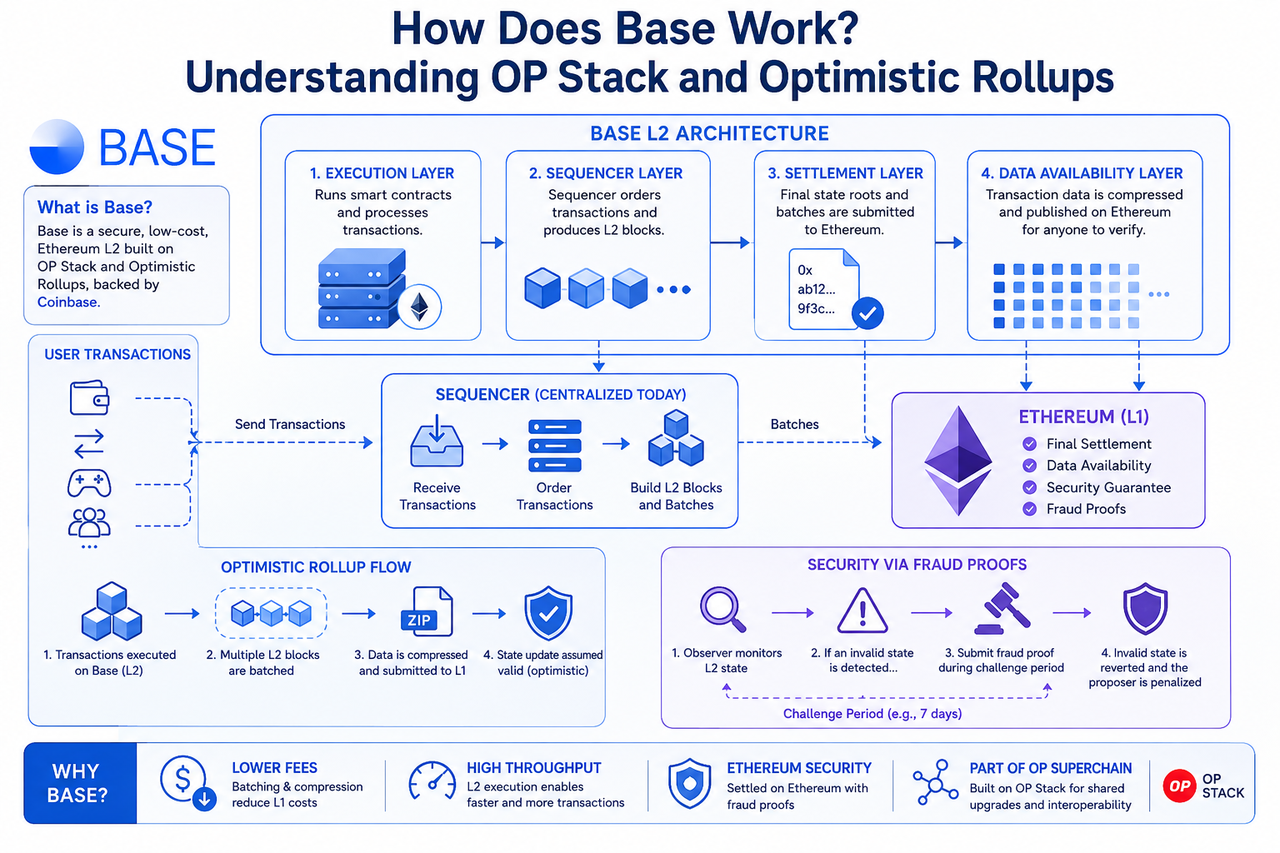
Base's technical architecture consists of four main layers: the execution layer, sequencer layer, settlement layer, and data availability layer.
The execution layer runs smart contracts and processes user transactions. Most on-chain activity takes place here, reducing the computational burden on the Ethereum mainnet.
The sequencer layer handles transaction ordering and block generation. Currently, Base uses a Sequencer to order transactions uniformly, ensuring efficient network operation and fast transaction confirmations.
The settlement layer is managed by the Ethereum mainnet. All transaction results are ultimately submitted to Ethereum, leveraging mainnet security for final settlement.
The data availability layer stores transaction data. Relevant information is compressed and published to Ethereum, allowing any participant to verify the authenticity of the Rollup state.
What Role Does the Sequencer Play in Base
The Sequencer is one of the core infrastructure components of the Base network. Its main responsibilities include receiving, ordering, and packaging user transactions.
When users send transactions to Base, the Sequencer prioritizes receiving them and generates new Layer 2 blocks in chronological order. These blocks are then packaged into Rollup batches.
Compared to submitting directly to the Ethereum mainnet, the Sequencer offers faster transaction confirmation. Users typically see execution results within seconds, without waiting for final mainnet settlement.
While the Sequencer improves network performance, it also raises concerns about centralization. As a result, Rollup networks usually plan to gradually increase the openness of their sequencing mechanism over time.
How Are Base's Transaction Data Submitted to Ethereum
Base does not submit each transaction individually to Ethereum; instead, it uses a batch processing method.
First, user transactions are executed on Layer 2. The system then aggregates multiple blocks into a single transaction batch.
These batches are compressed and sent to Ethereum. Because multiple transactions share the mainnet cost, the fee per individual transaction drops significantly.
Once the data is recorded on Ethereum, anyone can reconstruct the state of the Base network, ensuring transparency and verifiability of the Rollup system.
How Does Fraud Proof Ensure Network Security
Optimistic Rollup's security relies on the Fraud Proof mechanism.
The system assumes that submitted state updates are correct by default and does not perform complex verification immediately. If an observer detects an invalid state, they can submit a fraud proof during the challenge period.
Upon successful verification, the invalid state is reverted, and the parties involved may face penalties. This design allows the network to avoid continuous verification of all transactions while still maintaining a high security level.
Fraud Proof is one of the key differentiators between Optimistic Rollup and traditional sidechains, as its security ultimately derives from the Ethereum mainnet.
How Does Base Achieve Low Fees and High Throughput
Base's cost advantage stems mainly from transaction aggregation and data compression.
On the Ethereum mainnet, each transaction independently occupies block space. On Base, hundreds or even thousands of transactions can share a single mainnet submission cost.
Additionally, the Layer 2 network handles most computation locally, reducing the consumption of mainnet execution resources.
This design allows Base to achieve higher throughput and lower transaction fees while preserving Ethereum's security, providing a solid foundation for payments, gaming, and social applications.
How Does Base's Technical Architecture Differ from Arbitrum
Both Base and Arbitrum belong to the Optimistic Rollup family, but their underlying architectures differ.
Base is built on OP Stack and emphasizes interoperability with the OP Superchain. Arbitrum, on the other hand, uses the Nitro technical framework, independently developed by Offchain Labs.
In terms of ecosystem positioning, Base focuses more on consumer applications, payments, and social networks, while Arbitrum holds a stronger advantage in DeFi infrastructure.
Both inherit Ethereum's security, but they differ in development tools, ecosystem integration, and technical roadmap specifics.
Summary
Base's technical architecture is built on OP Stack and Optimistic Rollup. By moving transaction execution to Layer 2, using the Sequencer for transaction ordering, and relying on the Ethereum mainnet for final settlement, it strikes a balance between scaling efficiency and security. Its modular design enables deep collaboration with the OP Superchain ecosystem while offering developers an Ethereum-compatible environment.
FAQs
Why did Base choose OP Stack instead of building its own architecture?
OP Stack provides a mature modular framework and a complete set of development tools, reducing redundant development costs and ensuring compatibility with the OP Superchain ecosystem. For Base, this approach accelerates network deployment and ecosystem growth.
Are OP Stack and Optimistic Rollup the same thing?
No. OP Stack is a technical framework for building Layer 2 networks, while Optimistic Rollup is a specific scaling mechanism. Base uses OP Stack as its infrastructure and adopts Optimistic Rollup as its core scaling solution.
Where does Base's security come from?
Base's security ultimately derives from the Ethereum mainnet. All Rollup data is submitted to Ethereum, and the Fraud Proof mechanism is used to detect and correct any potential invalid states.
Does the Sequencer control the entire Base network?
The Sequencer is responsible for transaction ordering and block generation, but it cannot modify data that has already been submitted to Ethereum. The network's ultimate security remains guaranteed by Ethereum.
Why are Base's transaction fees lower than Ethereum's?
Base uses batch processing and data compression to aggregate a large number of transactions and submit them to Ethereum in a single batch. As a result, each transaction shares the mainnet cost, reducing Gas fees.
Author: Jayne
Disclaimer
* Legal Notice 1: This content does not constitute investment advice. It is not intended to promote the buying/selling of digital assets and is for informational purposes only. Crypto assets carry high risks and may be subject to significant price fluctuations. Before making any investment decision, you should assess your own financial situation and make an independent decision.
* Legal Notice 2: The data and charts provided in the article are for general informational purposes only. Although all content is carefully prepared, no responsibility is accepted for possible errors or omissions. The Gate TR Learn team may translate this content into different languages. No translated article may be copied, reproduced, or distributed without permission.
Share
Content
What Is OP Stack
What Is Optimistic Rollup
What Are the Core Components of Base's Architecture
What Role Does the Sequencer Play in Base
How Are Base's Transaction Data Submitted to Ethereum
How Does Fraud Proof Ensure Network Security
How Does Base Achieve Low Fees and High Throughput
How Does Base's Technical Architecture Differ from Arbitrum
Summary
FAQs


Sign Up
Related Articles

Beginner
The Future of Cross-Chain Bridges: Full-Chain Interoperability Becomes Inevitable, Liquidity Bridges Will Decline
This article explores the development trends, applications, and prospects of cross-chain bridges.
2026-04-08 17:11:27

Advanced
Solana Need L2s And Appchains?
Solana faces both opportunities and challenges in its development. Recently, severe network congestion has led to a high transaction failure rate and increased fees. Consequently, some have suggested using Layer 2 and appchain technologies to address this issue. This article explores the feasibility of this strategy.
2026-04-06 23:31:03

Intermediate
Sui: How are users leveraging its speed, security, & scalability?
Sui is a PoS L1 blockchain with a novel architecture whose object-centric model enables parallelization of transactions through verifier level scaling. In this research paper the unique features of the Sui blockchain will be introduced, the economic prospects of SUI tokens will be presented, and it will be explained how investors can learn about which dApps are driving the use of the chain through the Sui application campaign.
2026-04-07 01:11:45

Advanced
Navigating the Zero Knowledge Landscape
This article introduces the technical principles, framework, and applications of Zero-Knowledge (ZK) technology, covering aspects from privacy, identity (ID), decentralized exchanges (DEX), to oracles.
2026-04-08 15:08:18

Beginner
What is Tronscan and How Can You Use it in 2025?
Tronscan is a blockchain explorer that goes beyond the basics, offering wallet management, token tracking, smart contract insights, and governance participation. By 2025, it has evolved with enhanced security features, expanded analytics, cross-chain integration, and improved mobile experience. The platform now includes advanced biometric authentication, real-time transaction monitoring, and a comprehensive DeFi dashboard. Developers benefit from AI-powered smart contract analysis and improved testing environments, while users enjoy a unified multi-chain portfolio view and gesture-based navigation on mobile devices.
2026-03-24 11:52:42

Beginner
What Is a Yield Aggregator?
Yield Aggregators are protocols that automate the process of yield farming which allows crypto investors to earn passive income via smart contracts.
2026-04-09 06:13:50