Yeni başlayanlar için kılavuz
Tokenized Stocks, one of the most closely watched applications in the Real World Assets (RWA) space, use blockchain technology to allow traditional stock assets to circulate on-chain as digital tokens. This enhances accessibility, composability, and global transfer efficiency.
However, stocks are inherently heavily regulated securities. When mapped onto a blockchain, their legal nature does not disappear simply because the technology changes. Therefore, securities laws, custody systems, and investor protection mechanisms form the foundation for tokenized stock development and determine whether a project can operate compliantly over the long term.
Regulators generally do not judge an asset's nature solely by its technical form. Instead, they focus on the economic rights the asset represents.
If token holders can obtain stock-related income rights, dividend rights, price exposure, or other securities attributes, regulators typically treat the token as a security. In other words, even if the asset runs on a blockchain, as long as it corresponds to stock rights, it may fall under the securities regulatory framework.
This approach means blockchain technology changes how assets are recorded and transferred, not their legal nature. Consequently, tokenized stocks often must meet compliance requirements similar to those for traditional securities.
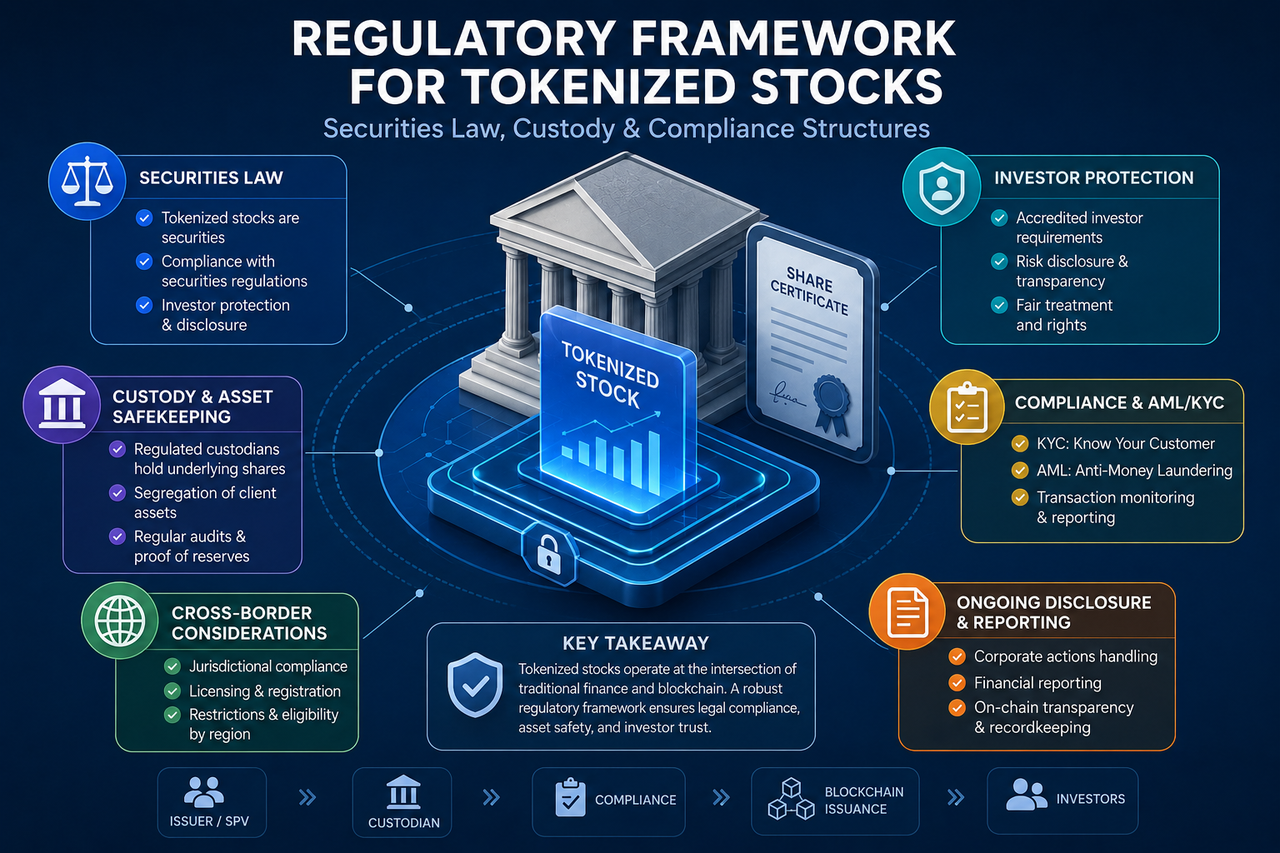
Securities law is the most critical legal foundation for tokenized stocks because they essentially involve the digital expression of stock-related rights.
In traditional financial markets, stock issuance must comply with disclosure requirements, investor suitability rules, and market oversight. When stocks are tokenized, these requirements generally extend to the on-chain environment rather than disappear.
Regulators focus on whether the issuer is legitimate, whether the underlying assets actually exist, whether investor rights are protected, and whether market manipulation risks exist. Therefore, most compliant tokenized stock projects design their legal frameworks around securities regulations.
The legal structure defines the relationship between the token and the underlying asset and is a key focus of regulatory review.
In this model, the issuer holds the actual stocks and issues tokens in a set ratio. Theoretically, there is a clear mapping between the token and the underlying stock.
This structure offers high transparency but often involves complex legal requirements for cross-border issuance and shareholder registration.
SPV is one of the most common legal structures in tokenized stocks. The issuer typically holds stock assets through a separate legal entity, which then issues the corresponding tokens.
SPVs enable asset segregation and improve legal clarity, making them widely used for tokenizing private equity and shares of unlisted companies.
Some tokenized stocks do not hold actual stocks. Instead, they track stock price performance through contracts or indices.
This model provides price exposure rather than actual shareholder rights. Therefore, it may be subject to both securities and derivatives regulations.
Custody mechanisms determine whether the underlying assets truly exist and whether investor rights are protected.
In traditional securities markets, stocks are held by regulated custodians. Tokenized stocks face the same issue because an on-chain token is not the same as the actual stock.
If the issuer cannot prove the underlying assets are properly custodied, the mapping between token and stock becomes unverifiable. That is why compliant projects typically engage third-party custodians, auditors, and periodic disclosure mechanisms to enhance transparency and credibility.
Anti-Money Laundering (AML) and Know Your Customer (KYC) are critical compliance components for tokenized stocks.
Traditional securities markets require investor identification and monitoring of abnormal trading. Tokenized stocks face similar requirements. Regulators want to prevent securities markets from being used for money laundering, fraud, or illegal fund transfers, so most compliant platforms require user identity verification.
In some jurisdictions, investor suitability checks are also mandatory. Some products are limited to accredited investors, while others may have investment thresholds based on local regulations.
Tokenized stocks are inherently global, but securities regulation is typically national or regional.
A single tokenized stock product may target investors from multiple countries, but jurisdictions differ on issuance rules, investor qualifications, and disclosure requirements. This inconsistency makes cross-border operations one of the most complex challenges in the space.
To reduce regulatory risk, many projects restrict participation from users in certain regions or use different legal structures and issuance methods for different markets.
Both are subject to securities regulation, but they differ significantly in how assets move.
| Dimension | Traditional Stocks | Tokenized Stocks |
|---|---|---|
| Asset Recording | Central securities depository | Blockchain ledger |
| Trading Hours | Exchange business hours | Depends on structure |
| Custody Method | Brokerage and custodians | Custodian + on-chain assets |
| Compliance Requirements | Securities law | Securities law + digital asset regulation |
| Cross-Border Circulation | Relatively restricted | Theoretically more efficient |
Despite different technical forms, investor protection, disclosure, and market integrity remain common goals. Tokenized stocks are more an upgrade to securities market infrastructure than a replacement for the regulatory system.
Tokenized stocks combine traditional securities with blockchain technology, so their regulatory framework spans securities law, asset custody, AML, KYC, and investor protection. Whether on-chain or off, if an asset represents stock rights or stock value exposure, it generally must follow securities regulations.
From direct shareholding to SPVs to derivatives, different tokenized stock products use different legal designs. But underlying asset authenticity, custody transparency, and investor protection remain the core regulatory focus.
In most jurisdictions, if a tokenized stock represents stock rights or stock value exposure, regulators treat it as a security. Therefore, such projects typically must comply with securities laws.
An SPV (Special Purpose Vehicle) isolates the underlying assets from the issuer and creates a clear legal relationship. This makes it a common legal structure for tokenized stocks and RWA projects.
Yes. Custody proves the underlying stocks actually exist and is essential for investor protection. Without custody, the link between the token and the real asset weakens.
Tokenized stocks are regulated financial products, so KYC and AML procedures are usually required. These measures help verify investor identities and reduce the risk of money laundering and financial crime.
Tokenized stocks change how assets are recorded and transferred, but they do not alter the legal nature of stocks. The regulatory, custody, and investor protection mechanisms of traditional securities markets remain essential for tokenized stocks to operate.
Paylaş
İçindekiler